SpaceX
SpaceX launches Bandwagon-4 rideshare mission with 18 satellites

On November 2, 2025, SpaceX launched a Falcon 9 rocket, featuring a Bandwagon-4 rideshare mission to orbit from Space Launch Complex 40 (SLC-40) at Cape Canaveral Space Force Station in Florida. This mission launched in mid-inclination orbit, which offers customers who want to expand their coverage or complete different objectives, not limited to Sun synchronous orbit.
The Falcon 9 fairings are carrying 18 satellites from SpaceX customers, including KOREA ADD, Exolaunch, Fergani, Tomorrow Companies Inc., Starcloud, and Vast. Here are the specific satellites in deployment order.
- 425 Korea – KOREA ADD
- TAURUS 1-4 – Exolaunch
- SEMI-2 – Exolaunch
- SEMI-3 – Exolaunch
- CEVROSAT-1 – Exolaunch
- LEMUR-2-AFFIE-WAUWIE – Exolaunch
- Haven demo – Vast
- Tomorrow-S8 – Tomorrow Companies Inc.
- SEMI-1 – Exolaunch
- ICEYE 2 – Exolaunch
- Tomorrow-S9 – Tomorrow Companies Inc.
- ICEYE 1 – Exolaunch
- FGN-100-d2 – Fergani
- Starcloud-1 – Starcloud
- ICEYE 3 – Exolaunch

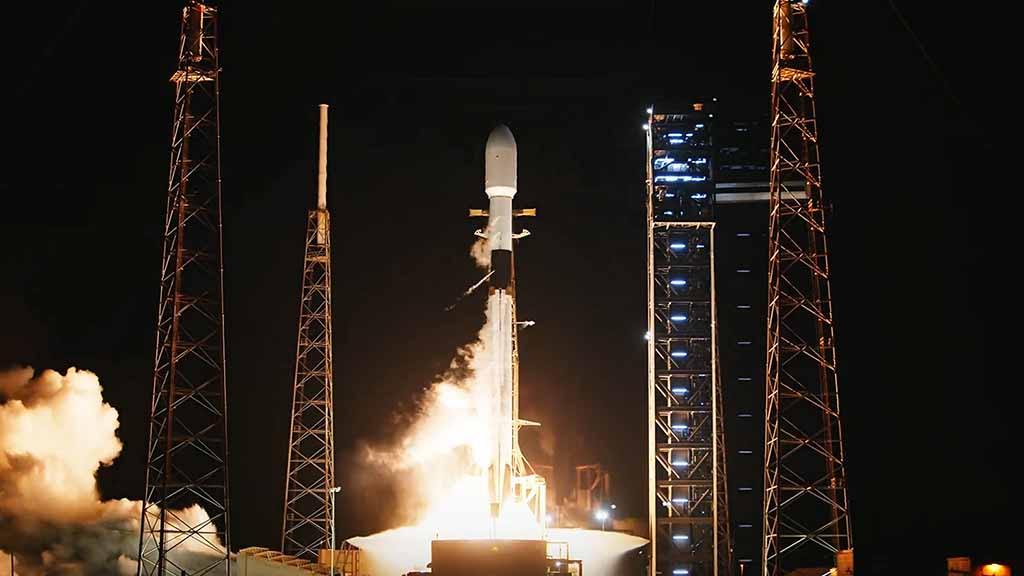
SpaceX Falcon 9 Bandwagon-4 mission liftoff
Mission Profile
Falcon 9 lifted off with nine Merlin engines firing at full power. At 1 minute and 12 seconds, the rocket reaches Max Q, the moment of peak mechanical stress.
Liftoff of Bandwagon-4! pic.twitter.com/8fZtX32zOz
— SpaceX (@SpaceX) November 2, 2025
The first-stage main engine cutoff (MECO) occurs at 2 minutes and 14 seconds, followed just four seconds later by separating the first and second stages. As the 1st stage performs a flip maneuver and begins its boostback burn, the 2nd stage engine ignites for its first start (SES-1) at 2 minutes and 26 seconds. The payload fairing separates at 2:41.
The first stage continues its descent, conducting an entry burn at 6:09 and a landing burn at 7:23, before landing at 7 minutes and 46 seconds on Landing Zone 2 (LZ-2) at Cape Canaveral Space Force Station.. This was the third flight for the first stage booster, which previously supported KF-02 and KF-03.
Falcon 9’s first stage has landed on Landing Zone 2 pic.twitter.com/zSuCOWYh7F
— SpaceX (@SpaceX) November 2, 2025
The 2nd stage completes its first burn with engine cutoff (SECO-1) at 9:38. It performed two more burns to adjust its orbit: SES-2 at 37:51 (lasting one second) and SES-3 at 59:30 (also lasting one second), before beginning payload deployments. At 1 hour and 14 minutes, SpaceX marked the final stage of deployment.
Deployment of all payloads confirmed pic.twitter.com/bfcRyexYHu
— SpaceX (@SpaceX) November 2, 2025