xAI
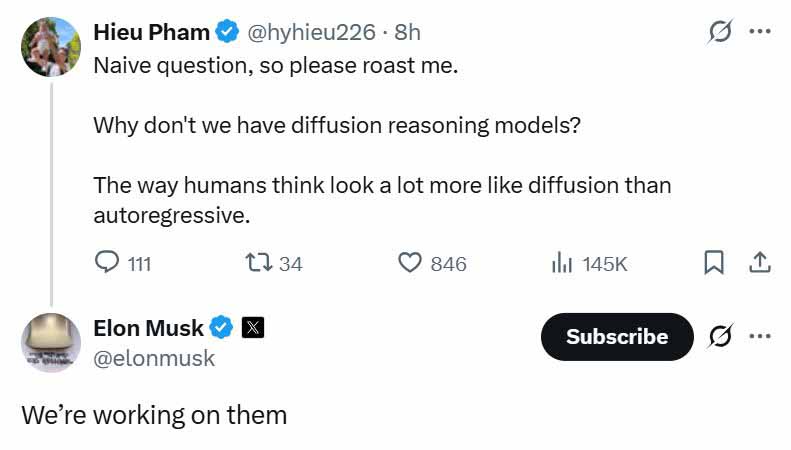
xAI Founder confirms development of diffusion reasoning models

xAI Founder and CEO, Elon Musk, has announced that his AI company is working on diffusion reasoning models to empower Grok AI for a more intelligent user experience. According to the information, xAI Grok primarily relies on autoregressive transformer-based architectures enhanced with multi-agent reasoning systems.
Diffusion reasoning models combine diffusion models with advanced reasoning techniques. They work by simulating a diffusion process starting with noise and iteratively denoising it to produce coherent outputs, such as images or text. In language modeling, diffusion-based approaches produce text in a non-autoregressive manner, which refines noisy drafts over multiple steps.
Diffusion reasoning models adapt dLLMs to handle logical, step-by-step reasoning by integrating techniques like Chain-of-thought (CoT) prompting or reinforcement learning (RL). It aims to enable dLLMs to “think” iteratively, self-correct, and scale performance on benchmarks, including arithmetic, logic, or planning, where autoregressive LLMs have dominated.
Here are the three major benefits of diffusion reasoning models:
- Efficiency: Parallel generation reduces inference time for long reasoning chains.
- Flexibility: Iterative denoising supports self-correction and adaptive depth in reasoning.
- Scalability: RL techniques like those in d1 allow models to improve via trial-and-error without needing massive new data.
Why no diffusion yet?
The Grok 4 and Grok 4 Fast, two of the latest xAI models, use an autoregressive reasoning system. Grok’s foundational design is derived from an LLM that generates outputs token-by-token in a sequence, autoregressive manner, predicting the next token based on all previous ones.
This system is built on transformer architectures, often incorporating Mixture-of-Experts (MoE) layers for efficiency, where specialized “expert” sub-networks handle different aspects of a query.
Therefore, the current stack prioritizes the maturity of autoregressive scaling, leveraging xAI’s Memphis AI Supercomputer for training. However, Musk’s comment on upcoming diffusion reasoning models suggests that xAI will move to a hybrid solution for future releases.
Currently, production Grok remains autoregressive for stability and broad applications. This allows the AI model to compete against rivals such as ChatGPT and provide unhindered API access for developers.