Blue Origin
Blue Origin’s New Glenn second flight (NG-2) escapes to space with ESCAPADE mission

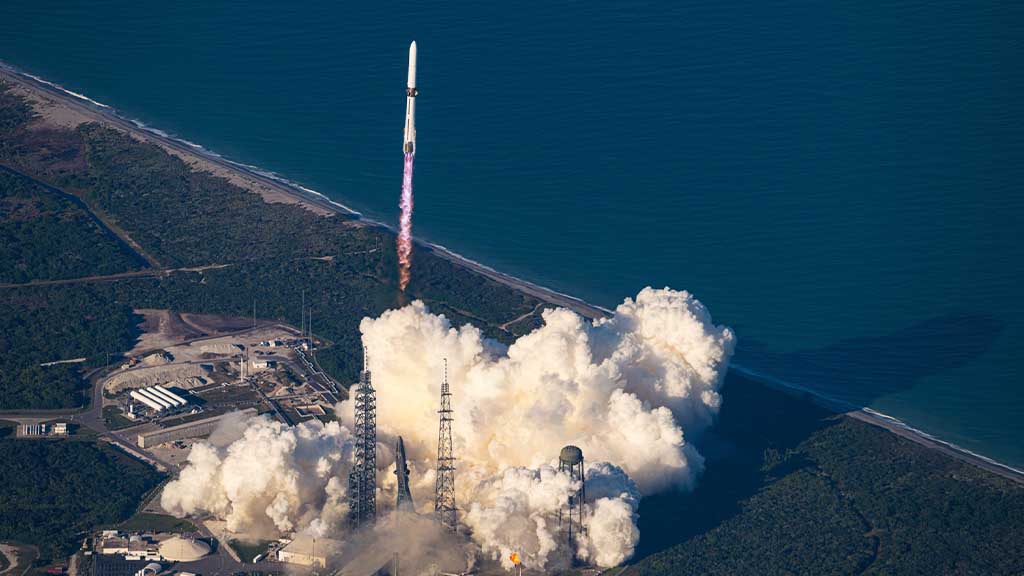
On November 12, 2025, Blue Origin launched the second New Glenn Flight (NG-2) from Launch Complex 36 at Cape Canaveral Space Force Station, carrying NASA’s ESCAPADE mission.
This mega rocket lifted off from LC-36 with seven BE-4 engines firing at full power and reached Max Q. After completing the stage separation, the first stage reoriented to the landing trajectory and performed a final burn before landing on Jacklyn, a landing platform hovering a hundred miles downrange in the Atlantic Ocean.
— Jeff Bezos (@JeffBezos) November 13, 2025
This is the first time Blue Origin has successfully recovered the New Glenn rocket booster, which is a significant milestone since it completed this move in its second flight.
Meanwhile, the two BE-3U engines fired up to take the second stage into orbit. After reaching the point of destination, the second stage marked fairing separation, activated the twin ESCAPADE satellites, and separated from the second stage to begin the journey to Mars.

ESCAPADE
ESCAPADE (Escape and Plasma Acceleration and Dynamics Explorers) mission consists of two spacecraft, designed and developed by Rocket Lab. These satellites are designed to work in coordination. These satellites are about the size of a mini-fridge, and weigh around 250 pounds (120 kilograms) excluding the fuel.
After deployment, these satellites will take around 11 months in interplanetary space before entering a highly elliptical orbit around Mars. This will start a six months gradually descending into the same nominal science orbit like pearls on a string, then passing within 100 miles of the Martian surface at closest approach.
Once at the destination, ESCAPADE spacecrafts will study Mars’ magnetosphere, the magnetized area of space around the planet, which interacts with the solar wind, and the processes driving its atmospheric escape.
With its onboard instruments, the ESCAPADE spacecraft measures magnetic fields, ions, and electrons to analyze how Mars’ magnetic field guides particle flow around the planet. It also defines how its energy and momentum are transported from the solar wind through Mars’s magnetosphere and what processes control the flow of energy and matter into and out of the atmosphere.