News
Tesla CEO spots a key hurdle for AI deployment in space

Tesla CEO, Elon Musk, highlighted a key hurdle in deploying AI into space, stating that deploying 1 terawatt per year of AI compute orbitally would require “more dollars than actually exist” without significantly cheaper chips.
This comment came amid Tesla’s decision to restart Dojo 3 development, driven by Nvidia’s prohibitive costs for custom supercomputing needs. The “1TW/year” figure represents an ambitious benchmark for annual AI compute deployment, powered directly by solar energy in orbit. Musk has long argued that terrestrial power constraints limit massive AI scaling on Earth, where average U.S. electricity consumption hovers around 500 GW.
In contrast, space offers abundant, uninterrupted solar power. With Starship’s capabilities, he estimates the ability to launch 300 to 500 GW per year of solar-powered AI satellites, potentially exceeding the entire U.S. economy’s intelligence processing every two years.
Musk described solar-powered AI satellites as “the only path” to achieve 1TW/year of AI deployment at a massive scale, enabled by Starship. He has also outlined future iterations: AI7 and Dojo 3, dedicated to space-based AI compute.

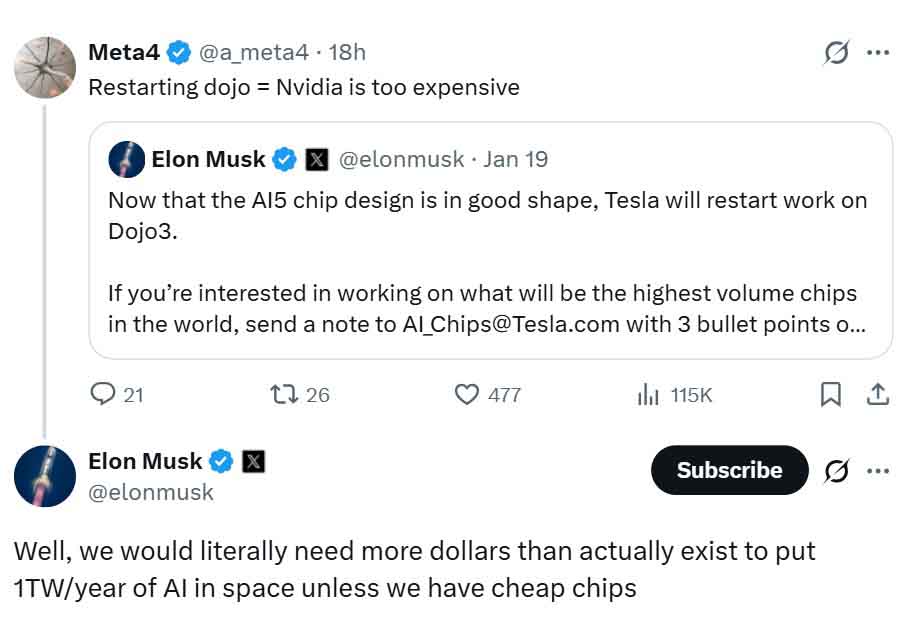
Tesla CEO, Elon Musk, has shared a key hurdle in deploying AI into space
For even greater ambition, lunar satellite factories using mass drivers could scale beyond 100TW/year, marking progress toward a Kardashev Type II civilization.
These ideas address fundamental bottlenecks, including chip production, launch capacity, and power supply. Terrestrial grids struggle with gigawatt-scale demands, pushing innovators toward orbital solutions where radiative cooling and constant sunlight eliminate many constraints. The SpaceX leader emphasizes that “1TW is a start,” pointing out that true AI proliferation demands terawatt-level infrastructure.
Tesla’s push for in-house, cost-effective chips directly supports this roadmap, making space AI economically viable. As Musk pursues gigawatt-to-terawatt transitions on Earth with projects like Colossus, the ultimate leap appears headed skyward—harnessing orbital solar for unbounded intelligence growth.
(source)