SpaceX
SpaceX plans massive 1 million Starlink satellites expansion

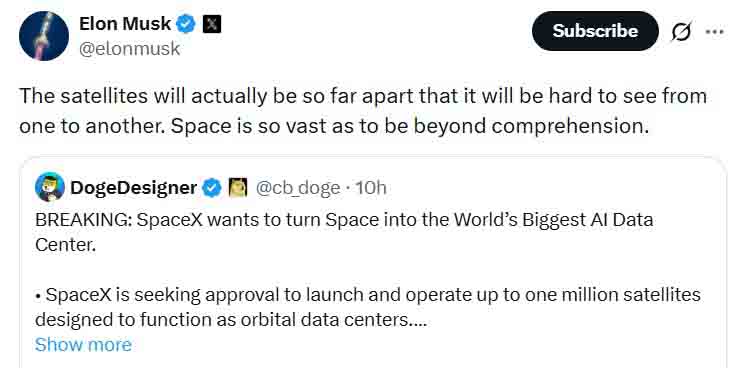
SpaceX’s Starlink constellation provides high-speed internet from low Earth orbit. The project has grown quickly, with thousands of satellites already launched. Elon Musk, Founder and CEO of SpaceX, confirmed the news of his company planning a massive Starlink satellite expansion into orbit, taking the constellation to more than 1 million.
Musk addressed concerns about satellite crowding. He explained that even with many satellites, they remain far apart. “The satellites will actually be so far apart that it will be hard to see from one to another. Space is so vast as to be beyond comprehension.” He highlights how space can accommodate large constellations without major issues.
Musk has discussed near-term goals for Starlink. He noted that the system could reach 20,000 to 30,000 satellites in operation soon, far outpacing other projects. Earlier updates mentioned over 20,000 next-generation satellites to be deployed in the coming years.
In a light-hearted post on the same day, Musk referenced even bigger scales. “Oops, did I say 1 million? I meant to say 1 billion.” This suggests long-term thinking could involve enormous numbers, far beyond current plans.

He mentioned 100GW per year of solar-powered AI satellites requiring matching computer power. He also described space-based industries as capable of using vast solar energy, potentially exceeding Earth’s economy by a huge margin.
Past posts from Musk reinforce that many satellites cause little notice. In 2019, he pointed out thousands already in orbit with minimal impact. He stressed the need for orbital telescopes due to Earth’s atmospheric limits.
Musk’s reaction to ideas of massive expansion shows assurance and humor. He emphasizes space’s size to ease density worries. The joking escalation from one million to one billion shows a bold vision for Starlink’s future role in connectivity, energy, and industry.
Current operations focus on tens of thousands, but Musk’s comments open the door to much larger possibilities over time