SpaceX
SpaceX Falcon 9 mission encounters second stage anomaly

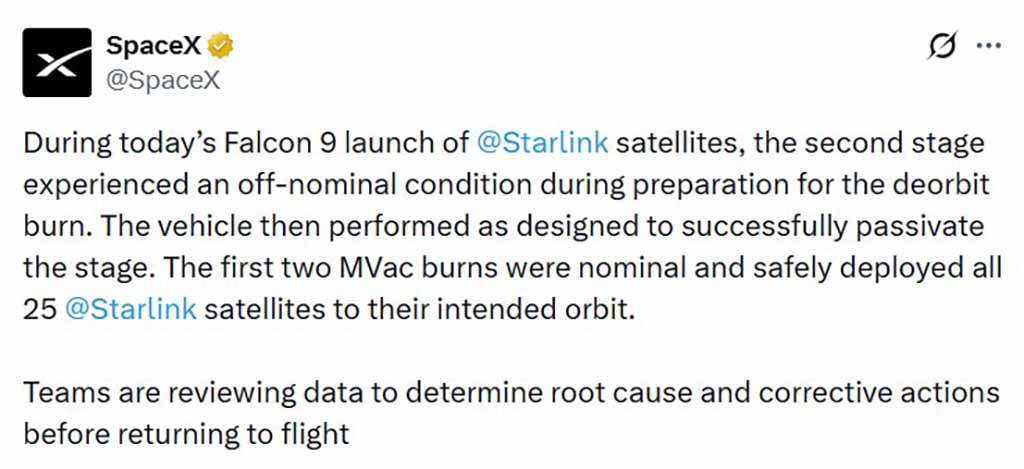
SpaceX has officially confirmed that the second stage of the Falcon 9 rocket has encountered an anomaly during the Group 17-32 Starlink satellite mission.
On February 2, 2026, SpaceX conducted a successful Falcon 9 launch from Space Launch Complex 4E at Vandenberg Space Force Base in California. The mission carried 25 Starlink satellites into low-Earth orbit.
The rocket’s first stage performed reliably, and the initial phases of the flight proceeded smoothly. The second stage completed its first two engine burns nominally, enabling the safe deployment of all satellites into their intended orbit.
However, an off-nominal condition arose later in the mission. As the second stage prepared for its deorbit burn, a critical maneuver designed to guide the stage into a controlled reentry over the ocean, the vehicle encountered an unexpected issue. This prevented the planned deorbit burn from occurring as intended.

SpaceX announced second stage anomaly for the Falcon 9 second stage
In response, the second stage executed its built-in safety protocols effectively. It successfully passivated itself by venting remaining propellants. This process ensures the stage poses no risk of explosion or generating orbital debris, even without the deorbit burn.
Passivation is a standard safety measure that depletes energy sources and reduces pressure in tanks, allowing the stage to reenter Earth’s atmosphere naturally and harmlessly over time.
The exact nature of the off-nominal condition has not been disclosed in detail yet. Such issues during engine preparation could stem from various factors common in rocket operations, including challenges with propellant settling, valve performance, or engine ignition sequencing for a restart.
SpaceX’s Merlin Vacuum engine on the second stage requires precise conditions for reliable restarts in the vacuum of space. Teams are currently analyzing telemetry data from the flight to identify the root cause.
Moving forward, SpaceX has initiated a thorough review process. This includes determining necessary corrective actions to address the anomaly. The company may pause upcoming Falcon 9 flights until the investigation concludes and any required fixes are implemented.
This cautious approach aligns with standard practices to maintain safety and reliability. Despite the second stage issue, the primary goal of delivering the Starlink satellites was achieved without impact.
The satellites are now in orbit and expected to begin operations normally. SpaceX’s rapid launch cadence in 2026 continues to support the expansion of the Starlink constellation, and resolutions to such anomalies typically allow for a prompt return to flight operations.
(source)