OpenAI
OpenAI launches Frontier, new platform for Enterprise AI agents

On February 5, 2026, OpenAI launched Frontier, a platform designed for large companies to create, launch, and oversee AI agents that perform practical job tasks.
AI tools have allowed workers in various departments to handle new kinds of work. Reports indicate that many enterprise employees now complete tasks that were not possible before. Over the past few years, more than one million businesses have used OpenAI products. In one semiconductor company, agents shortened chip optimization from six weeks to one day.
At a global investment firm, agents handled much of the sales process, giving salespeople over 90% more time with clients. At a major energy producer, agents raised output by up to 5%, leading to additional revenue.
Early users of Frontier include companies such as HP, Intuit, Oracle, State Farm, Thermo Fisher, and Uber. Other organizations, including BBVA, Cisco, and T-Mobile, have tested the platform for demanding applications.
Many companies face difficulties in fully using AI agents. Systems and data are often scattered across different platforms and applications. This fragmentation limits what individual agents can access and do. As AI models improve quickly, the difference grows between what the technology can achieve and what organizations can actually put into use. Teams need time to develop processes for moving agents from tests to regular operations.

OpenAI Frontier
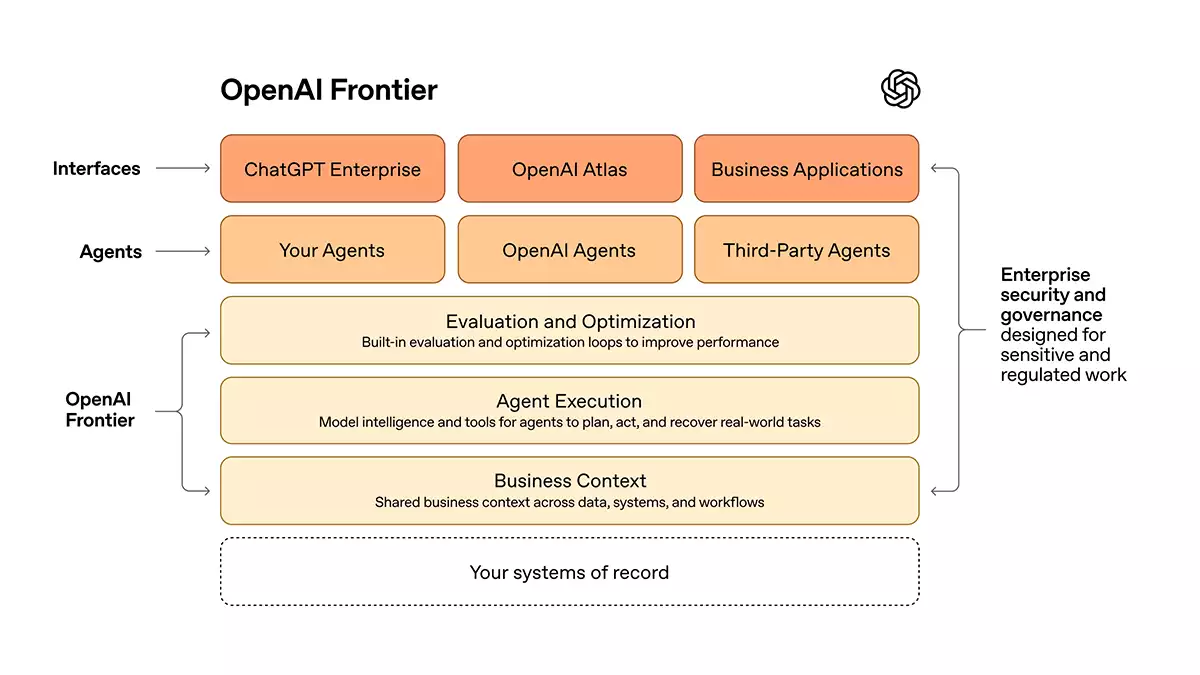
Frontier provides a complete system for handling these issues. It gives AI agents features similar to those employees need: shared information about the business, access to tools, learning from experience and feedback, and defined limits.
The platform connects to existing data storage, customer management systems, support tools, and internal software. This creates a common understanding of how work flows and where decisions occur. Agents can then plan steps, use files, run code, and interact with tools in a consistent environment. Over time, they store memories from past tasks to perform better.
Performance tracking helps identify areas for improvement. Each agent has its own identity with specific permissions, supporting use in regulated settings.
OpenAI staff work directly with company teams to apply lessons from past deployments. In one case, agents examined logs, documents, and code to find causes of hardware test failures, reducing the process from about four hours to minutes.
Frontier follows open standards, making it compatible with other AI tools and applications. A group of partners, including Abridge, Clay, Ambience, Decagon, Harvey, and Sierra, will develop solutions using the platform. OpenAI announced that Frontier is now available to a small group of customers, and expansion is planned for coming months.
(source)