SpaceX
Hexagon Purus sold aerospace technologies to SpaceX

Hexagon Purus, a company focused on zero-emission mobility solutions, announced the sale of its aerospace business to SpaceX. The transaction involves 100% of the shares in Hexagon Masterworks Inc., a North American unit that produces high-pressure composite storage cylinders for aerospace and space launch applications. The hydrogen mobility segment of Masterworks remains with Hexagon Purus, with related customer contracts transferring internally before closing.
The deal carries an enterprise value of about $15 million. This includes $12.5 million in cash at closing and a potential $2.5 million earn-out based on conditions. The sale aligns with Hexagon Purus’s ongoing review of its operations.
This divestment holds strategic importance for both companies. For Hexagon Purus, the aerospace business had grown steadily but reached a point where a dedicated space-focused owner could better support its development. The company sees limited near-term growth in North American hydrogen mobility markets.
By selling, Hexagon Purus is looking to improve its financial position and extend its liquidity runway. This allows full concentration on core priorities in clean energy solutions, such as hydrogen storage systems and battery packs for heavy-duty vehicles, buses, and maritime applications.
“I am pleased that we have found a new home for Masterworks with an owner that views our composite cylinder expertise as world-class and intends to integrate the business into its supply chain to support its long-term growth”, says Morten Holum, CEO of Hexagon Purus.

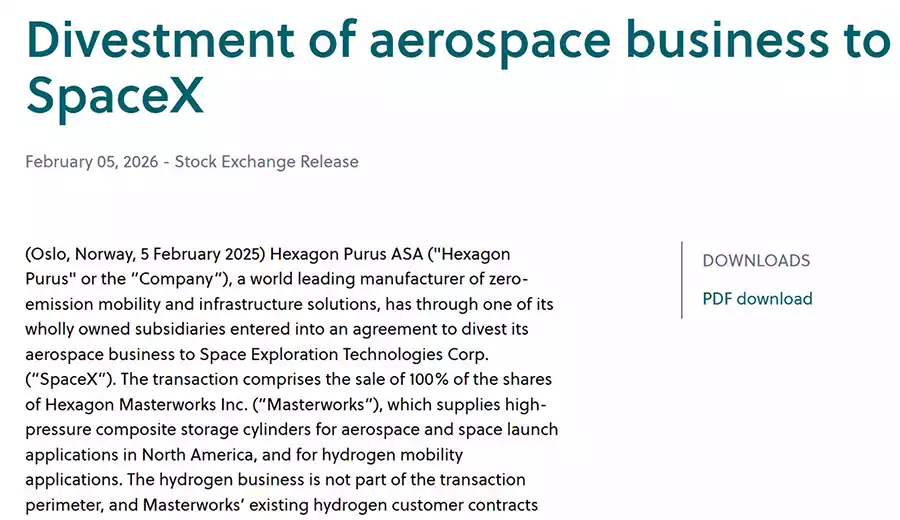
Hexagon Purus announces divestment to SpaceX
On the other hand, the space vehicle maker is gaining expertise in composite pressure vessels. These components are essential for reliable storage in launch vehicles and spacecraft. Adding this to SpaceX’s long-term expansion plans, including frequent launches and advanced programs like Starship.
Specifically, the acquisition enhances SpaceX’s supply chain control and technical depth. It aids in scaling production while maintaining high standards for safety and performance in space missions.
(source)