News
SpaceX prioritizing city on Moon first: Elon Musk

SpaceX is now aiming to establish a self-sustaining city on the Moon within the next decade, says Founder and CEO Elon Musk. Mars remains the ultimate objective, but a city there requires roughly two decades or more.
Meanwhile, Starship forms the foundation of both efforts. This fully reusable vehicle system carries massive payloads to the Moon and later to Mars. Rapid turnaround between launches allows frequent missions, which prove essential for delivering habitats, equipment, and supplies needed to build and expand a lunar city.
SpaceX collaborates closely with NASA on the lunar program. NASA selected Starship as the Human Landing System for the Artemis missions. Under this partnership, Starship transports astronauts from lunar orbit to the surface and returns them safely to orbit.
The contract supports multiple landings and provides critical funding and technical requirements that accelerate Starship development. These joint missions lay the groundwork for permanent lunar infrastructure.
The Moon’s proximity offers clear advantages. Launch windows open every few days, and transit takes only days. SpaceX’s mega rocket exploits this schedule to iterate quickly, test systems, and grow the settlement. Mars missions, by contrast, depend on 26-month planetary alignments and six-month travel times, which slow progress significantly.

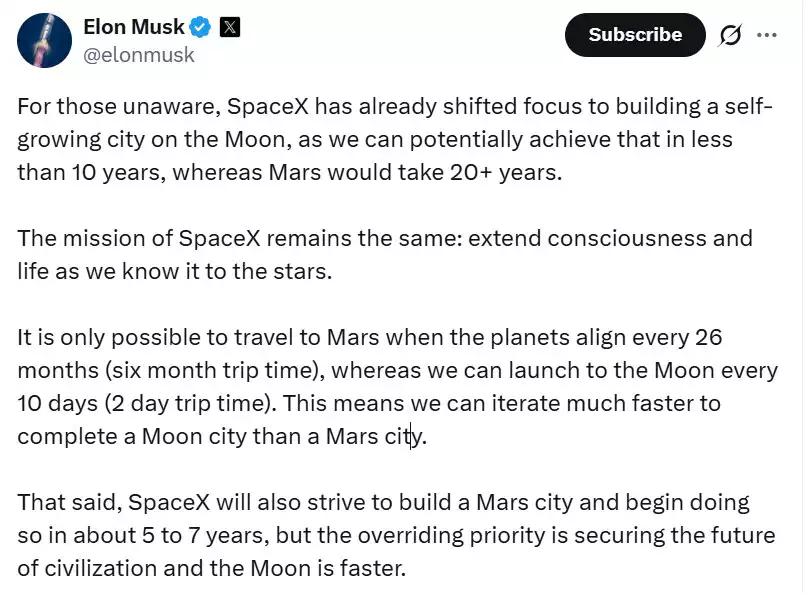
Elon Musk said SpaceX is switching focus to a city on the Moon first (Source – X/Twitter)
SpaceX is aiming to begin serious Mars city development in five to seven years. Uncrewed Starship flights will deliver initial cargo and infrastructure. Crewed missions follow once reliability reaches the required levels.
The lunar city serves as the proving ground, where technologies refined on the Moon, including life support, resource extraction, and habitat construction, can be directly transferred to Mars.
Success on the Moon demonstrates that humanity can live and work permanently off Earth. It builds operational experience, supply chains, and confidence for the longer journey to Mars.