ULA
ULA Vulcan Centaur rocket is ready to launch USSF-87 mission

United Launch Alliance (ULA) is prepared to launch its Vulcan Centaur rocket for the USSF-87 mission. This flight carries a critical national security payload for the U.S. Space Force.
The launch is set on Thursday, February 12, 2026, from Space Launch Complex-41 at Cape Canaveral Space Force Station in Florida. The rocket deploys a multi-manifest payload directly into geosynchronous orbit, over 22,000 miles above Earth.
The primary component includes the Geosynchronous Space Situational Awareness Program (GSSAP) system. On the other hand, GSSAP enhances the ability to detect, warn, characterize, and attribute disturbances to space systems in that high-orbit regime.
The U.S. Space Force Space Systems Command serves as the customer for this mission, which marks the second National Security Space Launch (NSSL) flight using the Vulcan rocket.
The Vulcan Centaur configuration for this mission, designated VC4S, features advanced propulsion and structural elements.

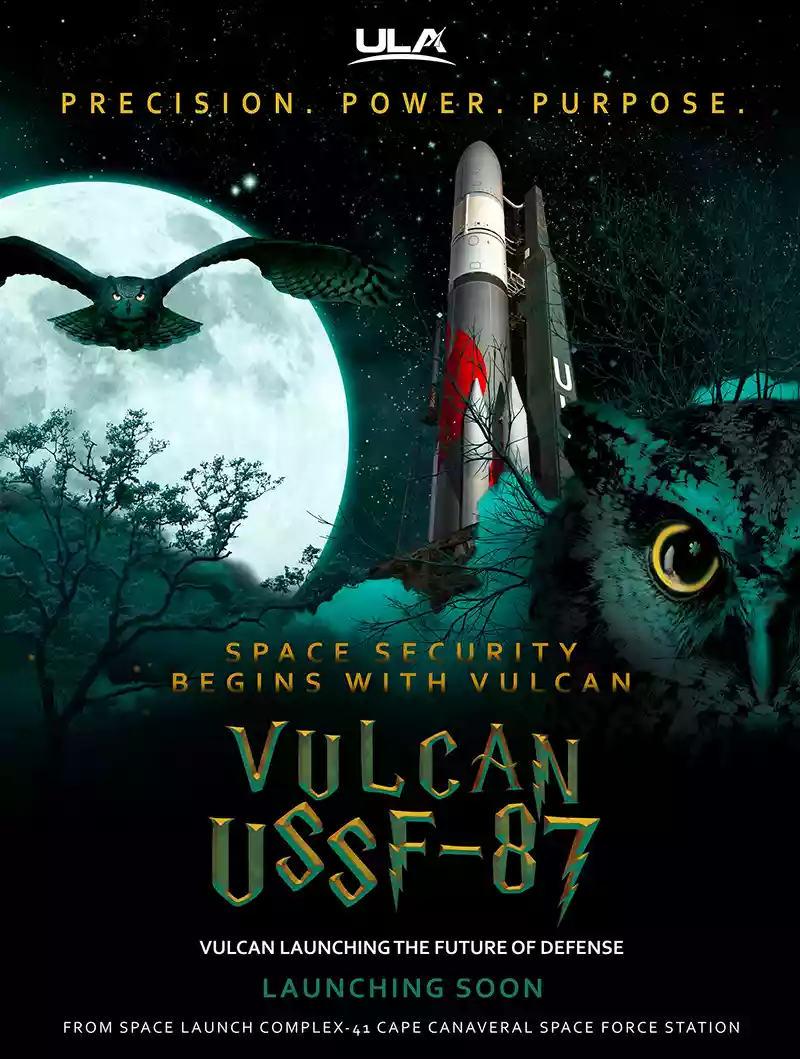
ULA Vulcan USSF-87
The booster stage measures 17.7 feet in diameter and 109.2 feet in length. It uses liquefied natural gas and methane fuel to power two BE-4 engines, each generating 550,000 pounds of thrust at sea level. Four graphite epoxy motor (GEM) 63XL solid rocket boosters supplement this power, with each delivering 459,600 pounds of thrust.
The Centaur V upper stage, 17.7 feet in diameter and 41.4 feet long, relies on liquid hydrogen and liquid oxygen. Two RL10C-1-1A engines provide 23,825 pounds of thrust each. A 17.7-foot-diameter payload fairing protects the cargo; engineers construct it as a two-piece shell with aluminum-honeycomb core and graphite-epoxy face sheets.
ULA employs a “clean pad” approach at the launch site. Teams assemble the rocket on a Vulcan Launch Platform inside the Vertical Integration Facility, then transport it by rail to the pad. This method streamlines operations at the historic Complex 41, originally built in the 1960s for Titan rockets.
Components for the Vulcan originate from facilities across the United States. Northrop Grumman fabricates solid rocket boosters in Magna, Utah. ULA handles engineering in Denver, Colorado, and booster assembly in Decatur, Alabama. Blue Origin produces BE-4 engines in Huntsville, Alabama, while Aerojet Rocketdyne builds RL10 engines in West Palm Beach, Florida. Beyond Gravity contributes the payload fairing in Decatur.
(source)