Anthropic
Anthropic launches Claude Sonnet 4.6 with 1 million context and adaptive thinking

Anthropic has officially launched Claude Sonnet 4.6, a significant upgrade to its mid-tier model that effectively bridges the gap between efficiency and flagship-level intelligence.
The new model introduces industry-leading features, including a massive 1-million-token context window and Adaptive Thinking engine, positioning it as the most capable model in its class.
Adaptive Thinking
The standout feature of Sonnet 4.6 is Adaptive Thinking. Moving away from static “reasoning” toggles, this architecture allows the model to dynamically allocate compute based on the complexity of a prompt. For straightforward queries, Sonnet 4.6 remains lightning-fast; for complex architectural planning or debugging, it engages in an internal monologue to verify logic before responding.
Early testers report that this “recursive reasoning” drastically reduces hallucinations, with the model often catching its own errors in the “thinking” stage, a crucial advancement for enterprise-grade reliability.
Impressive Benchmarks
Sonnet 4.6 dominates key performance metrics. On the SWE-bench Verified benchmark, it achieved a staggering 79.6%, nearing the performance of the flagship Opus 4.6 (80.8%). Its improvements in Computer Use are even more pronounced; scoring 72.5% on OSWorld-Verified, it represents a nearly five-fold improvement over the original Claude 3.5 Sonnet.

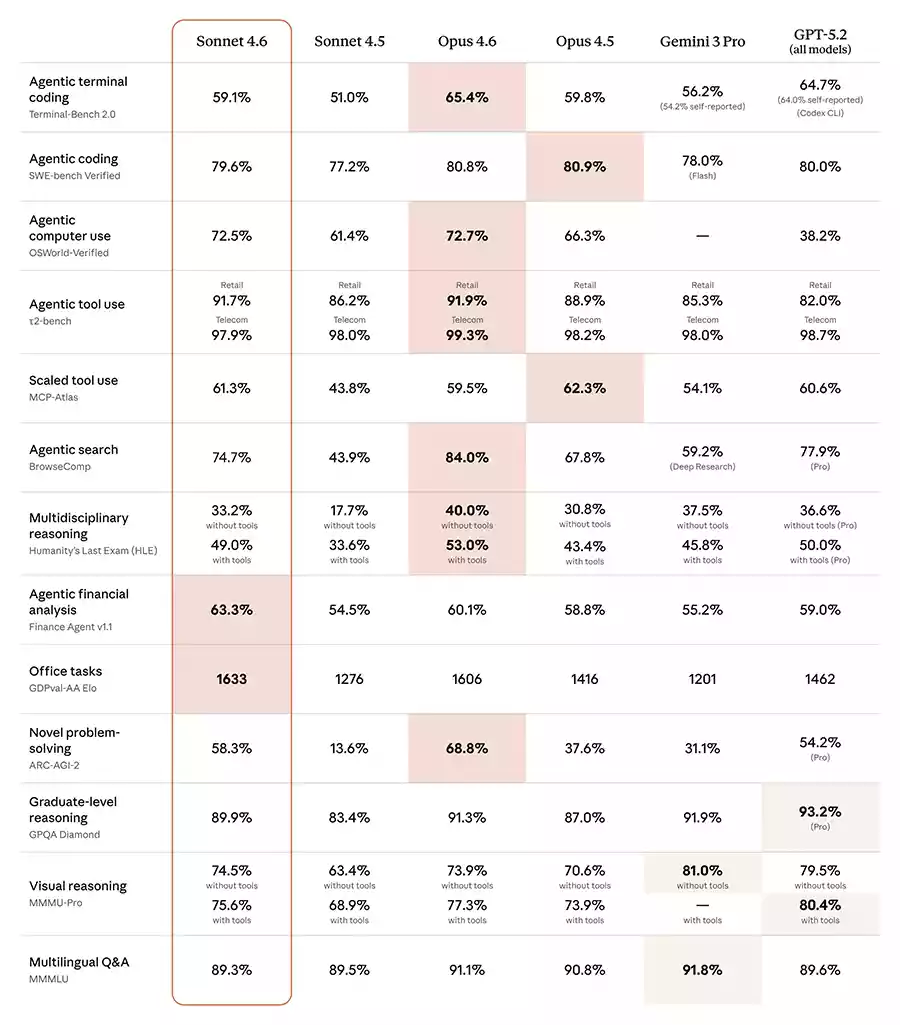
Anthropic Claude Sonnet 4.6 benchmarks
Key technical specifications include:
- Context Window: 1 Million tokens (Beta), capable of holding entire codebases or hundreds of research papers.
- Coding: Enhanced multi-file editing and agentic bug fixing.
- Finance: Ranked as the top model for agentic financial analysis (63.3% on Finance Agent v1.1).
Accessibility and Pricing
Pricing for Sonnet 4.6 remains unchanged from the 4.5 version: $3.00 per million input tokens and $15.00 per million output tokens.
The model is now the default experience for all Free and Pro users on Claude.ai. It is also immediately available via the Anthropic API, Amazon Bedrock, and Google Vertex AI. For developers, the integration with “Claude Code” enables 1M-token context compaction, allowing for deep-context coding sessions without the latency typical of large-window models.
(source)