SpaceX
Here is the first Starship V3 rolling for pre-launch testing

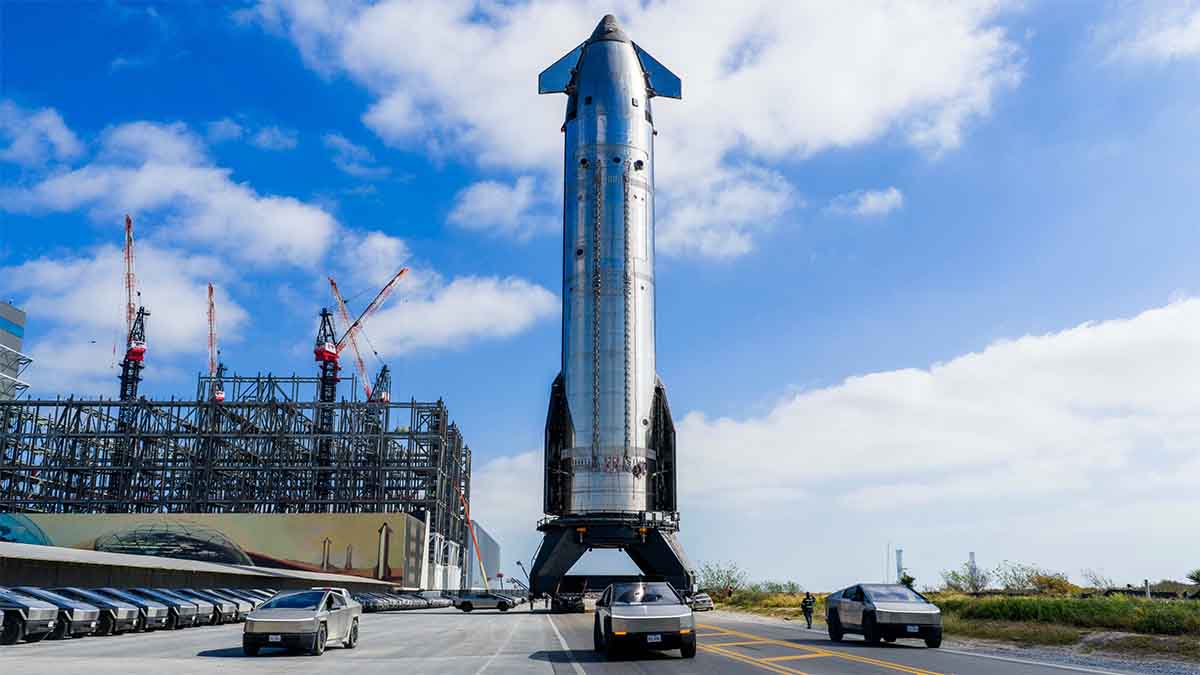
SpaceX has shared eye-catching images of the first Starship V3 vehicle rolling out from the factory toward pre-launch testing. The photos capture the massive rocket under bright blue skies at Starbase, transported on special vehicles and escorted by Tesla Cybertrucks.
One wide shot highlights the full height against the facility backdrop, while close-ups reveal the nose cone and fins covered in black hexagonal heat shield tiles. A group photo inside the high bay shows the team standing beneath the towering vehicle with its distinctive blue stripe running down the center.
Engineers design Starship as the upper stage of a fully reusable system that works together with the Super Heavy booster. The complete stack reaches 123 meters tall and measures nine meters across. Super Heavy powers up with 33 Raptor engines that burn sub-cooled liquid methane and liquid oxygen to generate massive thrust at liftoff. Starship carries six Raptor engines, including three for sea-level operations and three vacuum-optimized for space.
The booster holds 3,400 tons of propellant while Starship stores 1,500 tons. Together, they enable the system to lift between 100 and 150 tons of payload to orbit when flying in reusable mode. These specs support missions from satellite delivery to crewed trips to the Moon and Mars, aiming for rapid turnaround times.

The V3 vehicle advances the entire architecture. Teams have added docking ports and better propellant connection points that make on-orbit refueling smoother and more efficient. DragonEye navigation sensors and experimental gauging tools will also help track fuel levels accurately in microgravity.
The heat shield now features uniform hexagonal tiles across more surface area, which should handle reentry heat loads better than earlier versions. These improvements come directly from the data obtained during past flights.
The company is also doing the same for the Super Heavy booster. Engineers recently completed cryoproof testing on the first V3 booster, chilling the tanks to extreme temperatures to verify structural integration. Furthermore, teams test redesigned propellant systems and focus on better flow management during burns.
Earlier integrated flights already demonstrated full ascent profiles, boostback maneuvers, and successful tower catches. Raptor 3 engines with reduced parts count and improved thermal protection now power these boosters and deliver consistent performance across multiple relights. Stacking the upgraded booster with this new Starship V3 vehicle will mark another milestone in the push for routine reusability.
Based on Elon Musk’s statement, Starship Flight 12 could enter space as soon as March.