Blue Origin
Blue Origin Announces New Glenn Roadmap: Engine, Vehicle Upgrades and New Glenn 9×4

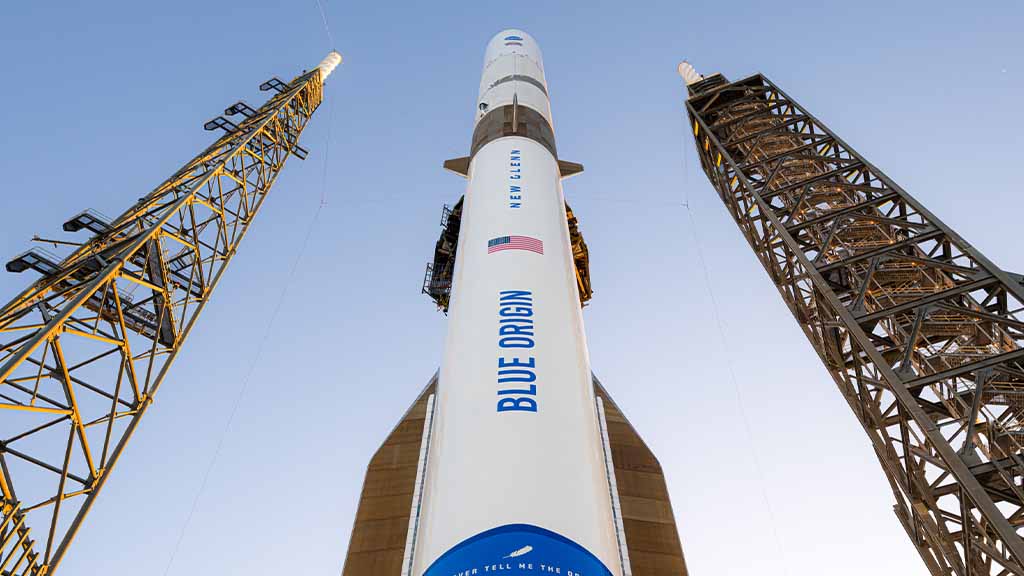
Blue Origin, the aerospace company founded by Jeff Bezos, is building on the momentum from its flawless second New Glenn flight (NG-2) by sharing an upgrade roadmap for this vehicle and its future capabilities.
The company recently launched NG-2, which not only delivered a NASA payload to space but also achieved the program’s first successful first-stage booster landing on the droneship Jacklyn. These developments position New Glenn as an increasingly competitive player in the orbital launch market, offering greater payload capacity, improved reusability, and more options for customers in low-Earth orbit (LEO), lunar, and deep-space missions.

Engine Upgrades
The core of the announced enhancements lies in propulsion improvements, driven by upgraded engines and the introduction of subcooled propellants.
First Stage (BE-4 Engines) The seven methane/oxygen BE-4 engines on the reusable first stage will see total liftoff thrust dramatically increase from 3.9 million pounds-force (17,219 kN) to 4.5 million pounds-force (19,928 kN).
Individual BE-4 engines have already demonstrated 625,000 lbf on test stands under current conditions, with 640,000 lbf expected soon. Subcooling the liquid oxygen and methane propellants (chilling them below standard boiling points to increase density) is the key enabler, boosting thrust well beyond the original 550,000 lbf per engine.
Second Stage (BE-3U Engines) The hydrogen/oxygen BE-3U engines on the upper stage are also receiving upgrades. The total vacuum thrust for the pair will rise from the original 320,000 lbf (1,423 kN) to 400,000 lbf (1,779 kN) over the coming missions. Test firings have already demonstrated that a single BE-3U can produce over 211,000 lbf, providing a clear path to enhanced performance.
These engine improvements, combined with subcooled propellants, directly translate to higher payload masses and more efficient trajectories for customers.
Vehicle upgrades
Blue Origin is also integrating several structural and operational enhancements to support higher launch rates and lower costs:
- Reusable payload fairings to enable rapid reuse and increased flight cadence.
- A new, lower-cost propellant tank design for both stages.
- An upgraded, reusable thermal protection system (TPS) on the first stage to withstand reentry heating better and speed up booster refurbishment.
- Avionics, structures, and recovery system refinements for greater reliability.
These changes will begin rolling out in phases, starting with the third New Glenn flight (NG-3) in early 2026.
New Glenn 9×4
The rocket maker will expand the New Glenn family with New Glenn 9×4, using nine BE-4 engines in the first stage, upgrading from seven in the current version. The second stage will use 4 BE-3U vacuum engines; 2 of these are used in the existing second stage.
With these engine counts, the New Glenn 9×4 will bring the following performance improvements:
- 70 metric tons to low-Earth orbit (LEO)
- 14 metric tons direct to geosynchronous orbit (GEO)
- 20 metric tons to trans-lunar injection (TLI)
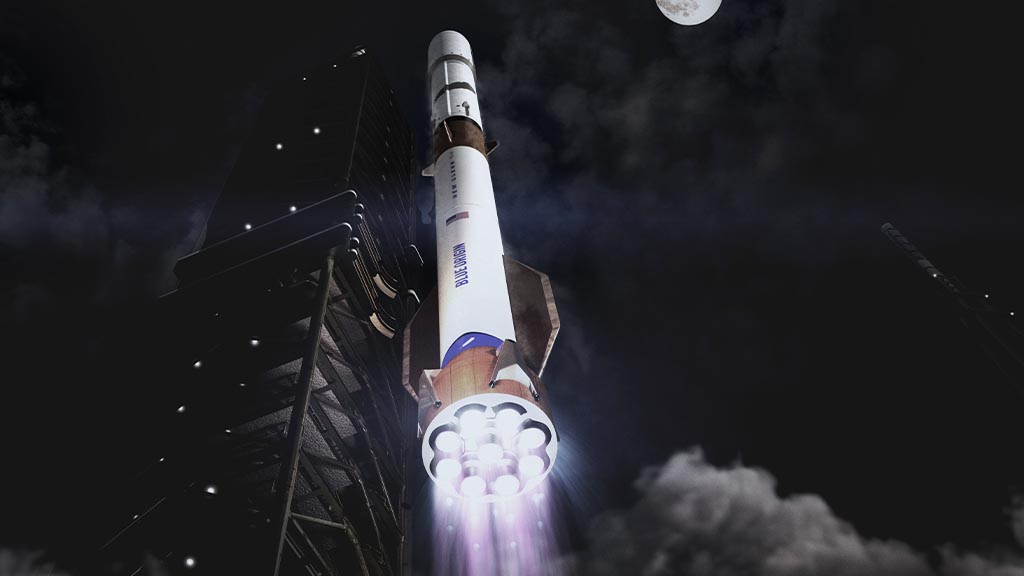
In terms of structural advancements, the 9×4 will feature a larger 8.7-meter diameter payload fairing compared to the standard 7-meter fairing. Both the original 7×2 configuration and the new 9×4 will fly concurrently. This will provide customers flexibility for everything from mega-constellations and national security payloads, such as the Space Force’s Golden Dome architecture, to lunar landers and deep-space probes.
(source)