Tesla
Tesla FSD V14 brings redundancy Improvement

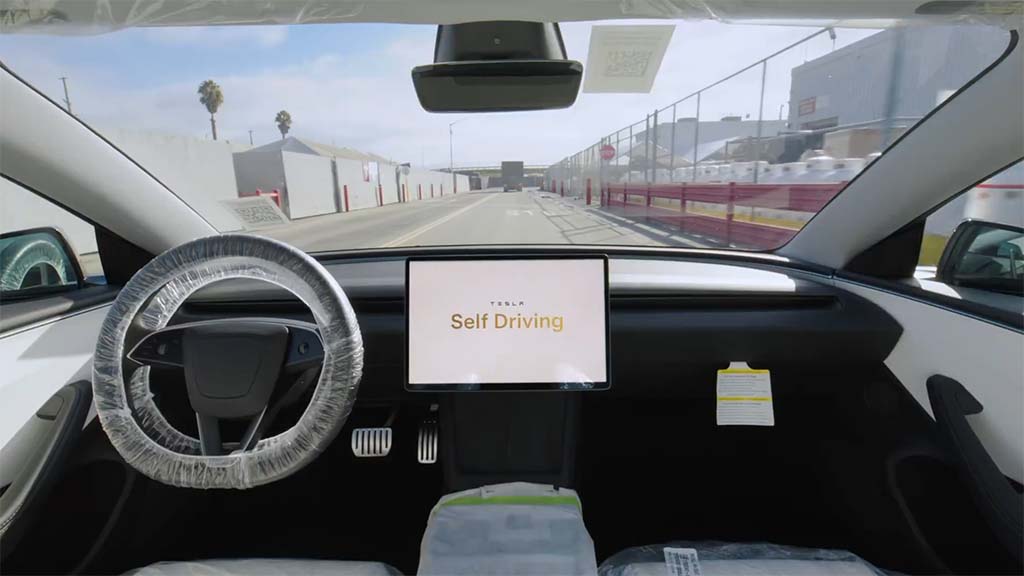
Tesla FSD redundancy improvement marks a significant step forward in the evolution of autonomous driving technology. Recent developments in Tesla’s Full Self-Driving (FSD) software reveal a shift to a more balanced and resilient system design.
In version 14, the EV maker has implemented an active-active failover mechanism across its dual compute nodes, distributing neural network weights more evenly at approximately 4.8GB and 5.2GB. This is a notable change from version 13’s uneven split of 2GB and 7.5GB, which relied heavily on one primary node.
This Tesla FSD redundancy improvement enhances system reliability by enabling both compute nodes to operate simultaneously. In the event of a failure in one node, the other can take over seamlessly without interrupting vehicle operation.
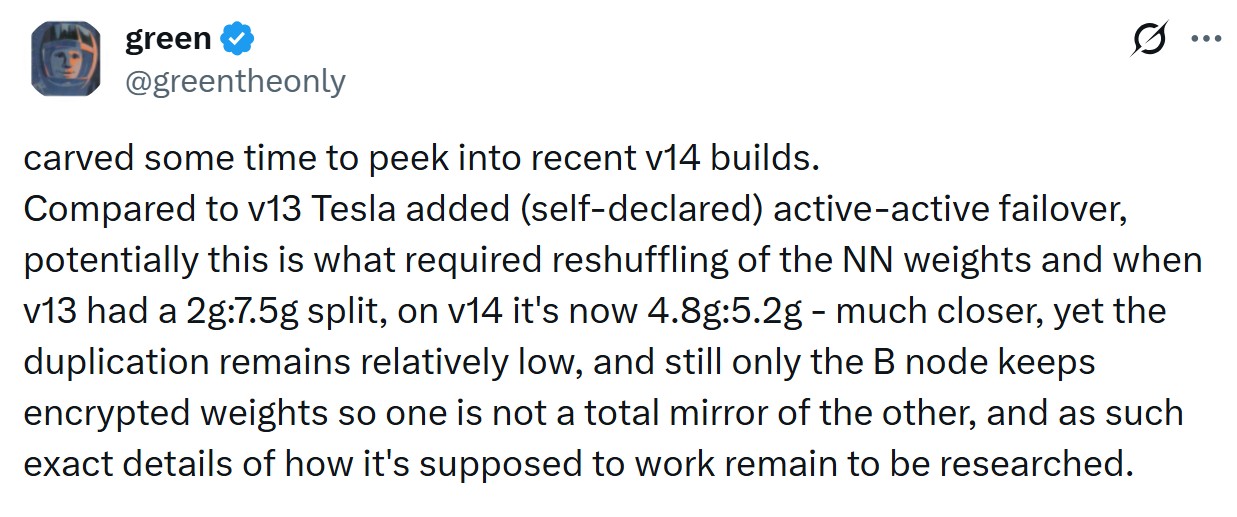
The design maintains minimal data duplication while keeping weights on the secondary node encrypted for security. These adjustments allow for real-time handoffs, contributing to greater stability during autonomous driving.
Insights from independent firmware analysis highlight additional refinements, including potential updates to sensor arrays and steering components. Such changes suggest preparation for future hardware iterations that could further boost performance. The non-mirrored node configuration indicates specialized roles for each unit, optimizing efficiency while preserving backup capabilities.
In the broader context of advancing vehicle autonomy, these enhancements align with industry goals for safer self-driving systems. Redundant architectures have been shown in automotive research to substantially lower failure risks, supporting progress toward higher levels of automation. By refining its compute setup, Tesla continues to prioritize robustness, bringing unsupervised driving capabilities closer to everyday reality.