News
Waymo announces 6th-generation driver rollout

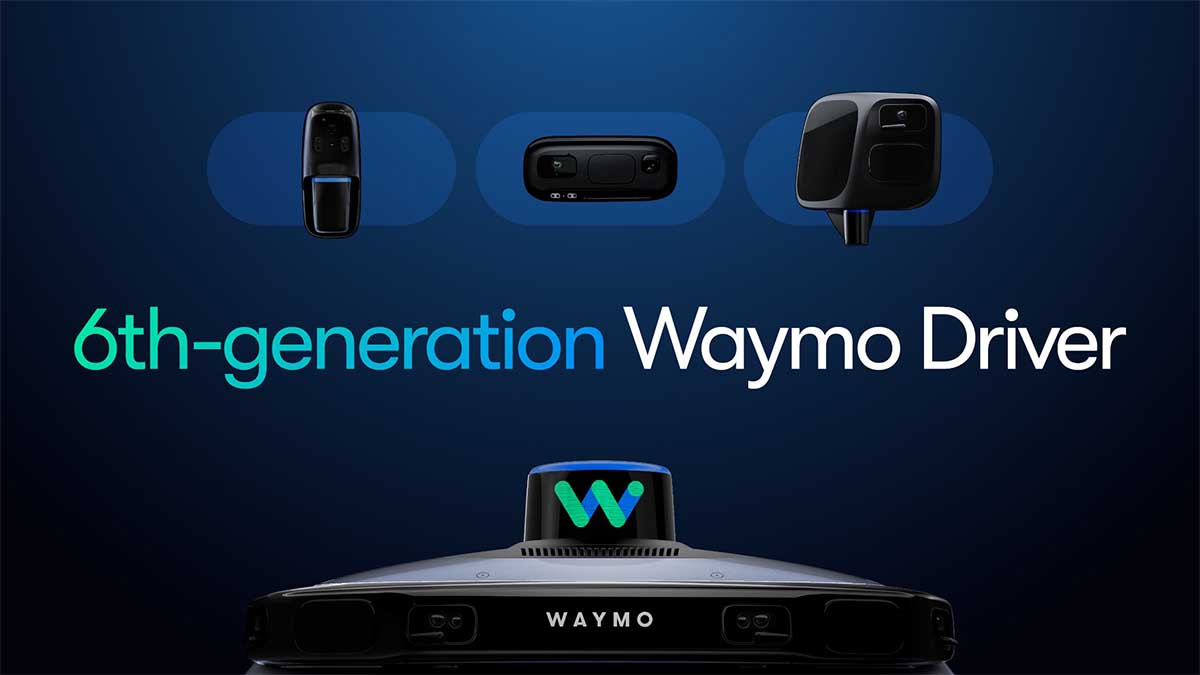
Waymo has announced it will begin fully autonomous operations with its 6th-generation Waymo Driver, marking a significant milestone in scaling the technology to more riders across additional cities.
This latest iteration features a streamlined configuration that reduces costs while upholding rigorous safety standards. Engineered for long-term growth and adaptability across multiple vehicle platforms, the system expands operational capabilities into diverse environments, including regions with extreme winter weather, enabling safer scaling at greater volumes.
The 6th-generation Waymo Driver builds on seven years of safety-proven experience, drawing from nearly 200 million fully autonomous miles accumulated in the densest areas of over 10 major cities and expanding freeway networks.
This real-world data underscores the need for resilient, multi-modal sensing. The system integrates high-resolution cameras, advanced imaging radar, and lidar as a unified suite to handle rare “long tail” events encountered during millions of weekly miles, ensuring comprehensive perception beyond any single sensor.
Advanced Vision System
The vision system surpasses human vision and standard automotive cameras with 360-degree awareness, exceptional dynamic range for handling deep shadows alongside bright glare (such as high beams or emergency lights), and superior low-light performance. At its core is a next-generation 17-megapixel imager offering sharp imagery, thermal stability, and high resolution.
This enables fewer cameras overall—less than half the number used in prior setups—while delivering better resolution, dynamic range, and sensitivity than the 5th-generation system, all at reduced cost. Integrated cleaning mechanisms maintain visibility in rain, grime, or ice, with lidar and radar providing redundancy when needed.
Lidar and Radar Enhancements
The 6th-generation lidar uses laser beams to generate detailed 3D point clouds, excelling in rain, snow, or darkness where vision alone struggles. Leveraging industry cost reductions, custom chips, and California-designed optics, it achieves longer-range detection, higher fidelity, and robustness at an optimized cost. Short-range lidars offer redundant, centimeter-accurate measurements critical for urban scenarios like detecting pedestrians or open doors.
Upgrades improve weather penetration and reduce distortions from reflective surfaces.
The imaging radar produces dense temporal maps tracking distance, velocity, and object size in all conditions, with next-gen algorithms enhancing performance in rain or snow through sensor fusion and machine-learned models.
Additional Sensing and Versatility
External Audio Receivers (EARs), positioned around the perception dome, detect and localize sirens or railroad signals, often before visual confirmation, while minimizing wind noise at speed.
The modular Driver design supports various platforms, such as the Ojai or Hyundai IONIQ 5, optimizing sensor placement and AI for each vehicle’s needs. Production is scaling at the Metro Phoenix factory toward tens of thousands of units annually, facilitated by OEM partnerships for Waymo-ready base vehicles.
According to the service provider, Initial fully autonomous trips on the Ojai will serve employees and guests for refinement before public rollout.
This 6th-generation advancement positions Waymo to accelerate expansion while prioritizing safety and efficiency.
(source)