SpaceX
SpaceX Starlink offering over 200 Mbps download speed, 50% increase in 2025

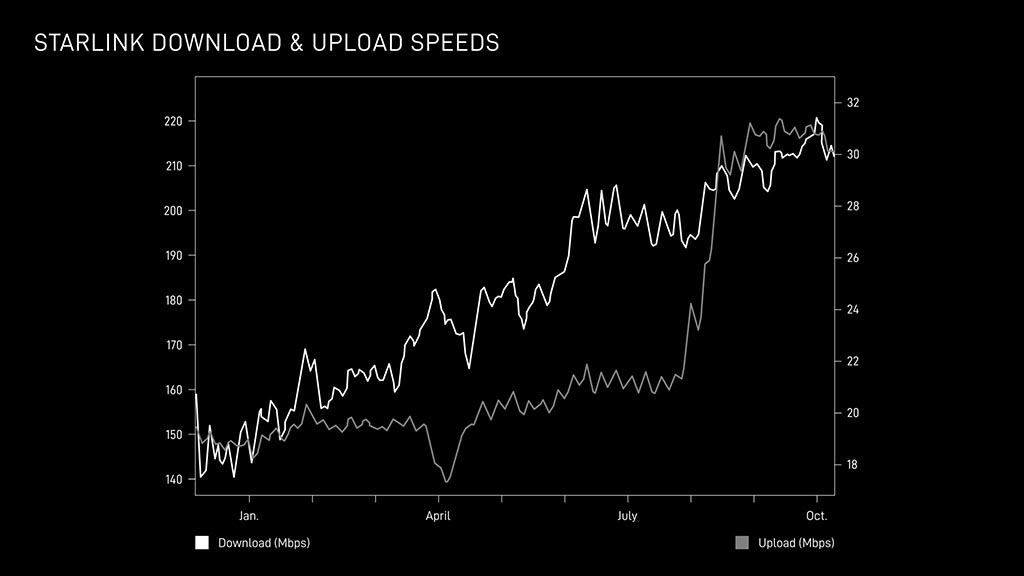
Michael Nicolls, VP of Starlink Engineering at SpaceX, has announced that this satellite internet service has seen more than a 50% increase in media peak-hour network-wide speeds, topping 200 Mbps. Here’s the download and upload speeds improvement over time this year.
January 2025 (Baseline)
- Download: Starts at approximately 150 Mbps, marking the year’s baseline.
- Upload: Begins around 20 Mbps.
- Trends: This serves as the reference point for the 50%+ gains. No prior data is shown, so it’s a flat starting line with minor initial fluctuations suggesting early-year variability, possibly due to seasonal demand or initial optimizations.
February 2025
- Download: Dips slightly to about 145 Mbps before recovering to ~155 Mbps by month’s end.
- Upload: Fluctuates between 18-19 Mbps, ending near 19 Mbps.
- Trends: A minor early dip in downloads (possibly weather-related or capacity testing), but quick stabilization. Upload shows subtle volatility, indicating network tuning in progress.
March 2025
- Download: Rises steadily to around 165 Mbps.
- Upload: Climbs to ~21 Mbps.
- Trends: First clear upward momentum for both lines, with download gaining ~10 Mbps from January’s low. This suggests initial satellite density improvements or software updates kicking in, reducing latency and boosting throughput.
April 2025
- Download: Peaks at approximately 190 Mbps mid-month before settling to ~185 Mbps.
- Upload: Increases to about 23 Mbps.
- Trends: Strong growth phase—download jumps ~20 Mbps from March, showing a sharp upward spike. Upload follows suit with steady gains. This aligns with potential V2 Mini satellite launches, enhancing coverage and reducing congestion.
May 2025
- Download: Holds steady at ~185 Mbps with minor wiggles.
- Upload: Plateaus around 23 Mbps.
- Trends: Consolidation after April’s surge; lines are relatively flat, indicating network stabilization as more users come online. No major dips, but the jaggedness hints at regional variations in peak-hour demand.
June 2025
- Download: Edges up to ~195 Mbps.
- Upload: Rises to ~25 Mbps.
- Trends: Gradual acceleration resumes, with download crossing 190 Mbps consistently. Upload shows a noticeable step up, possibly from beamforming or routing optimizations. The lines begin to parallel each other more closely, reflecting balanced improvements.
July 2025
- Download: Surges to a high of ~210 Mbps.
- Upload: Reaches ~27 Mbps.
- Trends: Peak growth month—download gains ~15 Mbps from June, with a prominent upward jag. Upload accelerates similarly. This could correlate with summer deployments or global expansion, pushing speeds toward the 200 Mbps threshold mentioned in the post.
August 2025
- Download: Dips slightly to ~205 Mbps before rebounding.
- Upload: Fluctuates around 27 Mbps.
- Trends: Brief consolidation with a small download pullback (perhaps due to higher global usage), but overall resilience. Upload remains stable, underscoring improved upload reliability compared to earlier months.
September 2025
- Download: Climbs back to ~215 Mbps.
- Upload: Increases to ~29 Mbps.
- Trends: Recovery and further gains, with downloads approaching the 220 Mbps ceiling. The line’s upward trajectory steepens, and upload nears 30 Mbps, highlighting software-level enhancements for asymmetric traffic patterns.
October 2025 (Current, as of post date)
- Download: Tops out above 220 Mbps (exceeding the y-axis max slightly for emphasis).
- Upload: Hits over 30 Mbps, around 32 Mbps at the peak.
Trends: Culmination of the year’s progress—download shows over 50% growth from January’s 150 Mbps, and upload more than doubles from 20 Mbps. The final points are the highest, with minimal jaggedness, suggesting mature network performance and the 26 ms median latency tie-in for low-jitter applications.