AI
AI Models launching in February 2026: Sonnet 5, GPT-5.3, Gemini 3 Pro, Grok 4.20 and more


The artificial intelligence (AI) community is buzzing with anticipation as February 2026 appears poised to deliver several significant models. Discussions across platforms highlight a cluster of advancements from leading developers, driven by ongoing competition to improve reasoning, efficiency, and specialized capabilities.
These developments reflect the rapid pace of progress in the AI industry, where new models frequently raise the bar for performance in coding, productivity, and multimodal tasks.
Anthropic is expected to introduce Claude Sonnet 5 in the early part of the month. The update is anticipated to bring meaningful gains in productivity, with particular emphasis on coding and advanced reasoning.
Developers and researchers could benefit from smoother workflows and more reliable handling of complex problems, building on the strengths of prior Claude iterations. DeepSeek plans to release its V4 model around mid-February.
Previews have drawn attention to a new Engram memory system that enhances long-context retention and code generation quality. This positions the model as a serious competitor in developer-focused tools, potentially challenging dominant players in areas like programming assistance and technical problem-solving.
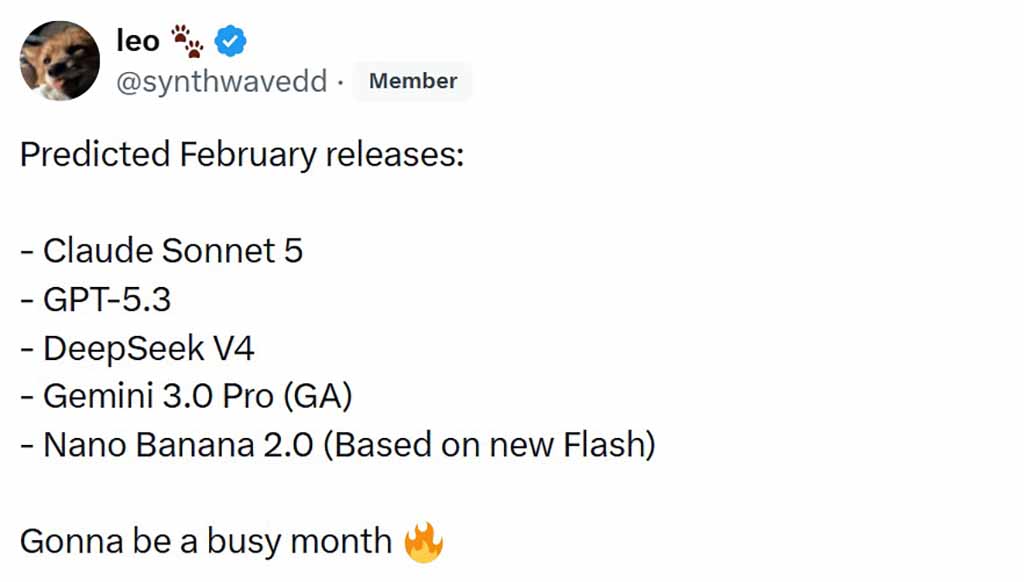
Google is also advancing its Gemini lineup this month. Gemini 3.0 Pro is slated for general availability, offering broader access to improved multimodal capabilities and reasoning. Alongside this, a lighter variant of Nano Banana 2.0, appears to target efficiency and speed, likely building on flash-based architectures for quicker inference without sacrificing performance.
These concurrent releases illustrate the intensifying race among AI laboratories. Each organization is prioritizing different strengths: deeper reasoning and safety alignment in Anthropic’s case, specialized memory mechanisms at DeepSeek, and scalable multimodal efficiency at Google.
The result is a diverse set of tools that cater to varying needs, from heavy-duty research applications to lightweight deployment on devices. For users, the month’s launches could translate into tangible workflow improvements.
Better coding assistants may accelerate software development, while enhanced reasoning could support more sophisticated analysis in fields like science, finance, and education. The focus on efficiency also suggests progress toward models that run effectively on consumer hardware, broadening access beyond cloud-dependent systems.
Besides, Grok 4.20 could also made a debut this month with improved performance and increased stability.
February 2026, therefore, marks a new milestone for AI models. As these models roll out, they are likely to spark fresh experimentation and integration across industries, further embedding advanced intelligence into everyday tools and processes.
(source)